4 Minute read
Life after graduate research: Dr Harvey Huang
Dr Harvey Huang researched how humans and learning algorithms behave in extreme market conditions known as tail risk events. Since graduating with a PhD, he has worked at NAB, developing and evaluating market risk models.
“A good PhD candidate should gradually develop the skill to tackle a difficult question with minimal external assistance. By the time they graduate, they are able to conduct a project independently,” says University of Melbourne PhD graduate Dr Harvey Huang.
Dr Huang has a PhD in Decision, Risk and Financial Sciences. It’s a five-year program, including two years of coursework and a three-year PhD.
You have to actually treat it as your career. Because as a PhD candidate, you're not a student anymore. Dr Harvey Huang
Dr Huang now works as a Senior Associate, Market Risk Models at NAB. During his PhD, he researched decision-making in extreme market conditions known as tail risk events.
Understanding this behaviour better could generate better learning algorithms in finance and economics, as well as curtailing market volatility in extreme events.
Learn more about our graduate research options
Understanding AI in finance and economics
The “tail” in tail risk refers to a bell curve, in which events happen less frequently the further you move from the centre. Dr Huang’s research examined events that happen rarely enough that they’re outside this bell curve entirely.
“To give an example, when COVID-19 hits and all the countries are imposing bans on traveling, it's a huge event,” he says.
This introduces market volatility. It causes market events that would normally be very rare to happen more regularly, and sometimes repeatedly.
And those conditions can affect people’s behaviour, causing them to behave more irrationally.
“We were trying to understand how we can stop irrational behaviours in people – and most importantly, AI agents,” Dr Huang says.
While modelling artificial intelligence agents’ behaviour is common in psychology, neuroscience and computer science, it’s a fairly recent topic in economics and finance.
“Currently all AI agents are evaluated in normal conditions. If you throw all the state-of-the-art agents in an environment that is extremely volatile, how would they behave?”
Additionally to receiving a PhD scholarship, Dr Huang was also lucky to have his family’s support.
“University funding helps a bit, but my family was really supportive. When I told them, ‘Look, I want to do a PhD,’ they said, ‘Yeah, go for it.’”
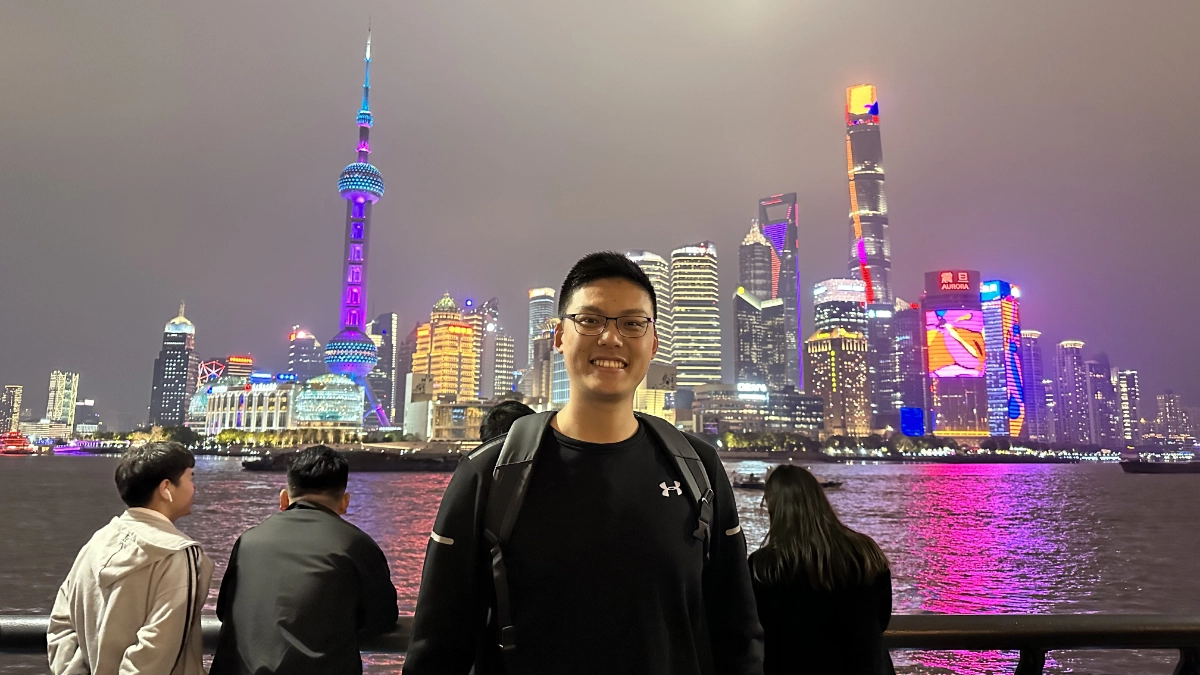
A PhD is a big commitment. But I did learn a lot throughout the process. I think it was worth it, at least for me personally. Dr Harvey Huang
Multidisciplinary collaborations benefit research
Dr Huang worked with psychologists, neuroscientists and computer scientists at the Centre for Brain, Mind and Markets during his PhD to model and predict learning algorithms’ behaviour.
“Collaborations really benefit you as a PhD researcher,” Dr Huang says.
The centre offers many learning opportunities, including journal clubs and semester-long coding workshops covering technical skills like R, Python, Latex and Git.
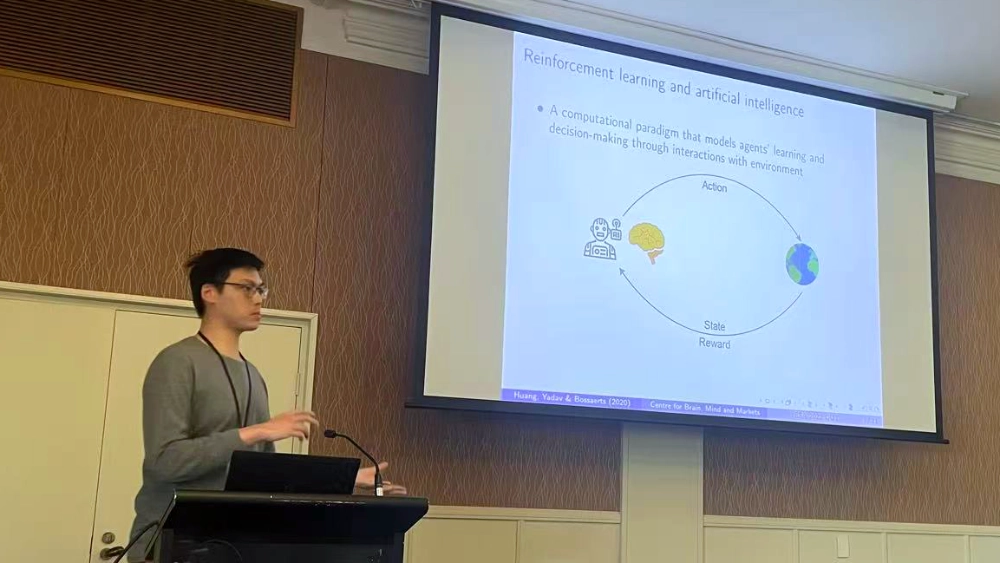
Confirmed candidates in the PhD program in Decision, Risk and Financial Sciences can draw on $15,000 in research conference travel funding. Dr Huang presented his research at a Reinforcement Learning and Decision Making conference in Montreal, Canada.
It gave him the opportunity to meet some of the world-leading researchers in the field, including the authors of research he admired.
The right PhD supervisor leads to success
Finding the right PhD supervisor is important. Making sure the topic you want to research is something that your potential PhD supervisor will be able to advise you on is part of this process, Dr Huang says.
“It's good advice to not just look at a supervisor’s profile but also follow up on what they were doing in the last five years. Because often they have multiple interests and research areas. And sometimes they can shift,” he says.
Dr Huang found his relationship with his supervisors evolved throughout his PhD, as he became more familiar with his PhD topic.
“As I progressed – especially for the most recent research – I often presented things that they found pretty useful as well."
I think the relationship between a PhD candidate and their supervisor is great, because we learn from each other. Dr Harvey Huang
A PhD can benefit industry careers
After graduating, Dr Huang started working as a Senior Associate, Market Risk Models at NAB.
“We look after market risk models used within the bank. My primary responsibility is to develop a model, test the model and document the model,” he says.
The technical skills Dr Huang developed during his PhD have been very useful in his work, including his coding skills and technical writing skills.
“It's not exactly the same as academic writing, but a PhD prepares you well to construct your views and provide valid evidence, which is quite important in my job as well.”
A PhD also prepares graduates to tackle difficult problems outside academia.
“An important thing you learn during your PhD is to independently carry out a difficult project by yourself from the start to the end – even when the project is out of your usual realm of knowledge,” Dr Huang says.
Dr Huang’s advice for new PhD candidates is to stay up to date with developments in their field.
"Try to keep up with the literature, know what you're doing, and in the meantime travel and talk to as many researchers in your field as possible,” he says.
And while Dr Huang advises new PhD candidates to approach their degree more like a job, it is also a time to experiment and learn.
“Try not to be too upset with reviewers’ comments and simply enjoy research.”
Learn more about a PhD in Decision, Risk and Financial Sciences
First published on 2 September 2025.
Share this article
Keep reading
-
Why research with us
Explore the benefits of undertaking your graduate research at the University of Melbourne.
-
Your research options
Explore your options as a graduate researcher at the University of Melbourne.
-
Your study experience
Discover what it's like to be a graduate researcher. Find out about University life, support services, and opportunities for skills development.
-
How to apply
Find out how to apply for graduate research at the University of Melbourne.