4 Minute read
Life as a graduate researcher: Tejas Menon
Tejas Menon researches how our immune systems respond to the flu – and how that changes as we age. The research may eventually lead to better flu vaccines. But for Tejas, improving our understanding of the immune system is motivation enough.

“You should not underestimate the flu,” says Medicine, Dentistry and Health Sciences PhD candidate Tejas Menon.
Healthy adults deal well with influenza. But young children can die from the flu.
Our next pandemic could also be caused by the flu – like the 2009 swine flu pandemic. The US Centres for Disease Control and Prevention are currently tracking the transmission of H5N1 from dairy cows to humans.
Tejas hopes to better protect young children and elderly people from influenza. He studies killer T cells.
“They're a type of immune cell which is really important in clearing viral infections like influenza. For my project, I’m interested in how killer T cells specific for influenza viruses change with age,” he says.
Tejas mostly works with blood samples from human donors. He conducts experiments like exposing T cells in the blood to different influenza fragments to see how they respond.
What it feels like to publish research in a top journal
Together with his coworkers, Tejas recently identified 9 new fragments of the influenza B virus that provoked a strong immune response from killer T cells. The research was published in Nature Communications.
“It's my first first-author paper as well. That's always a big milestone for any researcher,” he says.
Tejas was at a research lecture when the paper was due to be published online. He kept refreshing the link on his phone – until it finally worked.
“I sent the link to my supervisors, and then I sent it to all my family and friends. I basically stopped paying attention to the talk,” he laughs.
Though still in early stages, Tejas hopes that T cell research will lead to a better flu vaccine.
Current flu vaccines rely on a person’s antibodies to bind to the surface of the virus. That stops it from entering their cells.
Unfortunately, the virus’s surface is prone to mutation. And once the antibodies can’t recognise the virus, the vaccine goes out of date.
What we're really hoping for is a T cell-based vaccine. T cells are more robust against changes to the virus because they target proteins that are inside the virus. Tejas Menon
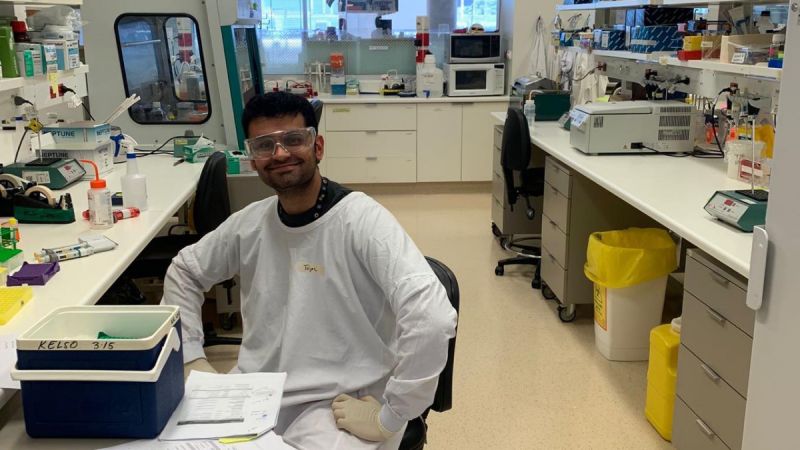
World-leading researchers supervise PhD candidates at the University of Melbourne
Tejas first went to university to study medicine. His father and grandfather are both doctors.
“But what appealed to me about medicine wasn't necessarily practising medicine. It was more the science and biology that interested me,” he says.
Wanting to understand how things work drove him toward research. He was completing his honours in immunology when the COVID-19 pandemic hit.
He noticed many research articles on COVID-19 were coming out of the Doherty Institute. The Doherty Institute is a joint venture between the University of Melbourne and the Royal Melbourne Hospital.
Outside of China, Doherty Institute researchers were the first in the world to grow SARS-CoV-2, the virus that causes COVID-19.
Tejas works in the research group of Professor Katherine Kedzierska. Professor Kedzierska won the 2023 Eureka Prize for Infectious Disease Research in recognition of her pioneering exploration of COVID-19 immunology.
Having decided to apply for a PhD, Tejas sent an email to Professor Kedzierska.
“I was lucky enough for her to be keen to take me on,” Tejas says.
He receives a living stipend through his supervisor. Some PhD supervisors offer funding for graduate researchers through research grants.
“Scholarships at the University of Melbourne were very competitive. If you study very hard, that will really help your chances to get a stipend,” he says.
The Doherty Institute is a supportive environment for PhD candidates
In Professor Kedzierska’s research group, Tejas works with honours and masters students, graduate researchers, research assistants and postdoctoral researchers.

Our lab is a really supportive environment. People help you if you want help on your experiments or if you need advice on how to do something. Tejas Menon
“Occasionally we like to sneak off to the pub,” Tejas says.
Tejas splits his time between working at his desk and the immunology lab. He enjoys the variety in his days.
“The Doherty is really just a great place to work,” he says.
“Other labs are always keen to share equipment. They're keen to share reagents and expertise as well. God knows I've borrowed lots of stuff!”
The Postgraduate Student Society for Infection and Immunity is another great way to meet people, Tejas says. They often organise events for graduate researchers, like social events and career workshops.
Through the workshops, Tejas has connected with PhD graduates who work in the pharmaceutical or biotechnology industries, government and even financial consulting.
“Doing a PhD just shows a lot of patience and tenacity,” he says.
But personally, Tejas plans to look for a postdoctoral research position after his PhD.
“I think a lot more blue-sky research happens in academia. In industry, the research is more translational,” he says.
“I like the discovery aspect more, and the biology is the most interesting thing to me.”
Learn more about a PhD in Medicine, Dentistry and Health Sciences
First published on 2 July 2024.
Share this article
Keep reading
-
Why research with us
Explore the benefits of undertaking your graduate research at the University of Melbourne.
-
Your research options
Explore your options as a graduate researcher at the University of Melbourne.
-
Your study experience
Discover what it's like to be a graduate researcher. Find out about University life, support services, and opportunities for skills development.
-
How to apply
Find out how to apply for graduate research at the University of Melbourne.