5 Minute read
Life as a graduate researcher: Rita Adjei
Education is key to a more sustainable society. PhD candidate Rita Adjei is evaluating how sustainability is captured in higher education policies. Through opportunities available at the University of Melbourne, she is becoming a leader in sustainability.
“The PhD is not really about the thesis. It's about the formation and who you become in that process,” says University of Melbourne PhD candidate Rita Adjei.
Rita’s PhD in Education is giving her a competitive edge as a sustainability professional. She researches sustainability in higher education.

Universities can help build a more sustainable world
“We know that higher education institutions are really crucial in transforming society and building the next generation of leaders,” Rita says.
The fourth United Nations Sustainable Development Goal (SDG) centres equitable and inclusive quality education.
“Higher education institutions are a means of implementing the SDGs through their students – but also as a target of the SDGs. They can embody these principles to demonstrate what sustainability looks like in society,” Rita says.
Rita looks at sustainability across the whole institution, from education to research, governance, campus operations and community outreach and partnerships.
“The aim is to assess the extent to which sustainability is a priority, or the extent to which sustainability has been captured in the policies of the higher education institutions,” she says.
The University of Melbourne welcomes international researchers
Rita wants to help our society become more sustainable. She enjoys the academic environment. But a PhD also attracted her as the highest educational achievement she could get.
“I knew that I was going to get to whatever heights that I wanted to get to,” she says.
When she reached out to Professor Marcia McKenzie as a potential supervisor, Rita was still in Ghana. Professor McKenzie was about to leave Canada for the University of Melbourne.
She agreed to follow Professor McKenzie to Melbourne. She was accepted to the University and received a Research Training Program Scholarship to support her research.
She also found a community to welcome her.
“The African Studies Group welcomes all African students regardless of their background or their academic discipline,” she says.
Rita likes to attend University of Melbourne events that encourage cultural exchange.
The sense of community is something that I really appreciate. You get to see people who might understand your struggles being somebody coming from an international background.Rita Adjei
A PhD can be a treasure trove of professional development opportunities
Rita has found many ways to expand her PhD experience through the University of Melbourne.
She has worked as a tutor in sustainability and climate change subjects. She works as a research assistant for her PhD supervisors on big national and international projects. She has volunteered for the Green Impact program.
Rita even works in the University of Melbourne sustainability strategy team, learning how the University is making its operations more sustainable.
“I've had access to so many resources and other opportunities that have really helped my journey,” she says.
But perhaps her most transformational experience so far has been Rita’s Wattle Fellowship. The fellowship is the University of Melbourne’s one-year program for training global leaders in sustainability.
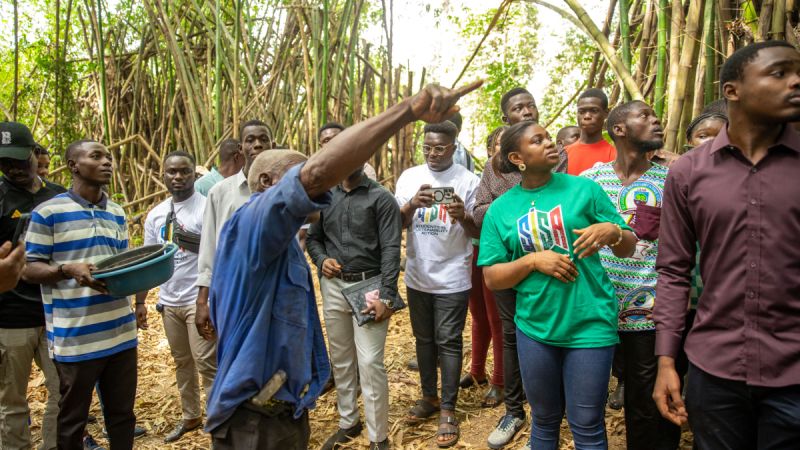
People who have this common interest in sustainability can come together to share ideas and make impacts across all disciplines. Rita Adjei
The Wattle Fellowship funds fellows to develop leadership and professional skills. And fellows receive funding to implement a project for sustainability action.
Rita’s PhD explores sustainability in higher education top-down, from a policy level. For her sustainability action project, she took the bottom-up approach. She wanted to see if she could get tertiary students to change how they thought about sustainability.
She organised a sustainability week for the University of Energy and Natural Resources in Ghana, co-designing its curriculum with students and lecturers at the university.
“The objective for this project was to give students a place-based approach to sustainability education. You have to build that connection to a place before you can really care for it,” Rita says.
Students at the university were hugely interested in the event. 200 students registered in the first 24 hours.
“I had to take the link down because I didn’t have the capacity to support so many students! And still we had people attending who had not even registered,” Rita laughs.
As part of the event, Rita held a competition for students to design their own sustainability initiatives. The Vice-Chancellor of the University pledged his support to winning students.
“I knew that I had done something good,” Rita says.
How to get the most out of your PhD
It took some time for Rita to find her feet in Australia at the beginning of her PhD.
“I was struggling a bit, especially having come from another country – with culture shock and having to deal with so many other new things,” she says.
But the experience has helped her build resilience. Her PhD has given her the confidence to go exploring on her own.
“A PhD helps you understand yourself and how you function better, because it is a very individualistic journey,” she says.
“I'm willing to challenge myself – to put myself out there for all these opportunities. Where that may take me, I don't know. But I know that I'm headed in the right direction. And that's all that matters.”
First published on 7 August 2025.
Share this article
Keep reading
-
Why research with us
Explore the benefits of undertaking your graduate research at the University of Melbourne.
-
Your research options
Explore your options as a graduate researcher at the University of Melbourne.
-
Your study experience
Discover what it's like to be a graduate researcher. Find out about University life, support services, and opportunities for skills development.
-
How to apply
Find out how to apply for graduate research at the University of Melbourne.