4 Minute read
Life as a graduate researcher: Mark Allan
Cities must become more sustainable and equitable. Experienced architect and urban planner Mark Allan saw how University of Melbourne research could benefit his career and major projects at the City of Melbourne. His part-time PhD research is creating a framework for better urban regeneration projects.

“As a seasoned professional – if I can use that expression – some of the younger PhD candidates ask, ‘Why are you completing a PhD when you already have an established career?,” laughs University of Melbourne PhD in Engineering candidate Mark Allan.
Mark is an architect and urban planner. When he started his part-time PhD, he was a senior executive at the City of Melbourne. He was set to become the Director of the City of Melbourne’s Greenline project.
The Greenline Project is a $300 million urban renewal project improving the environment, ecology and public open space along the north bank of the Yarra River-Birrarung.
Among other topics, Mark’s research investigates how urban practitioners can measure the success of projects like this, using frameworks that incorporate the UN’s Sustainable Development Goals.
“I had a really supportive employer who encouraged me to undertake doctoral research of relevance to the city,” he says.
How a PhD can benefit professionals with established careers
Urban planning and design are always evolving. Mark sees his PhD as an opportunity to add to his formal qualifications – which include a bachelors and a masters degree from the University of Melbourne.
“I am committed to professional development and learning which can add so much to our personal and professional lives. Formalising this, I think, is actually really important,” he says.
The academic discipline and research techniques that graduate researchers learn through a PhD can directly benefit people who work in industry.
“One of the realities for many practitioners is that business as usual enables you to progress only so far. Applying innovation and broadening your skills equips you to better respond to changing market demands,” Mark says.
Learn more about our graduate research options
Measuring urban regeneration projects against Sustainable Development Goals

Cities occupy only a small fraction of our planet’s surface. But they account for most of our global energy consumption and greenhouse gas emissions.
“Cities are at the heart of managing rapid population growth and realising social, economic and environmental benefits. They present opportunities to mitigate the impacts of climate change,” Mark says.
Public spaces also affect people’s lives and wellbeing. Well-designed spaces can improve the resilience of communities in the face of disasters and economic instability.
Mark’s research helps make cities more inclusive, safe, resilient and sustainable – together with the communities who live there.
“There was a time where urban renewal and urban regeneration was imposed upon communities,” he says.
“But we now know that the most successful urban improvement projects are those that have been developed with community input and ongoing participation.”
Mark is developing a framework to measure the performance of people-centric urban regeneration projects. And he is investigating how technology could enable them.
Digital twins, for example, can create a virtual representation of the physical world.
“We can use visualisations to better engage with communities, reimagining urban futures and testing scenarios well ahead of building them in the real world,” Mark says.
Collaborate with other graduate researchers
Mark enjoys working in interdisciplinary teams of urban practitioners including engineers and data scientists.
I get to collaborate with some very bright people from very different disciplines.Mark Allan
Graduate researchers in the Faculty of Engineering and Information Technology are based in Melbourne Connect, the University of Melbourne’s innovation precinct.
“We have a fabulous workplace environment at Melbourne Connect. If it isn't the greenest building in the city, it's certainly one of them,” Mark says.
“The public spaces in this building are quite spectacular. The views are gorgeous.”
The University creates opportunities for graduate researchers to learn academic skills and receive feedback. But Mark’s cohort also makes their own opportunities to get together.
“I’m one of the more senior graduate researchers. But I’m not the only one,” Mark says.
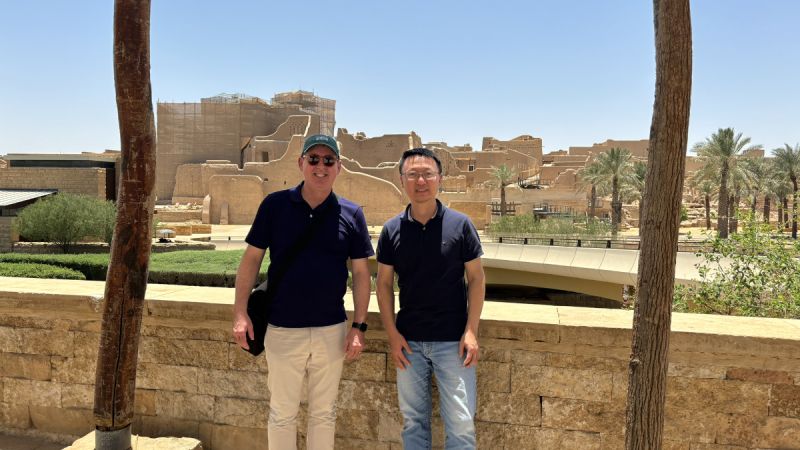
There’s also a fantastic cohort of young people who come from around the world. That’s one thing that surprised me – the diversity of graduate researchers in the faculty. Mark Allan
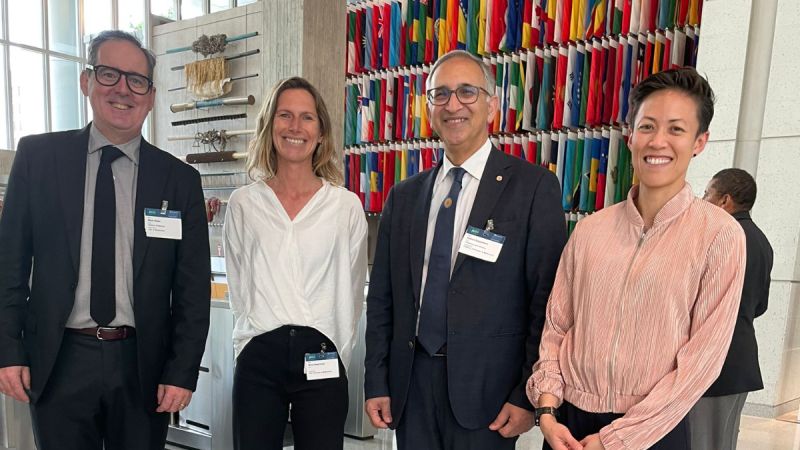
Mark’s research with the Centre for Spatial Data Infrastructure and Land Administration has also opened new international networks to him. He was part of the centre’s delegation that travelled to Washington DC, USA to present his research and support colleagues who are completing projects for the World Bank.
A PhD can lead to unexpected opportunities
Nearing the end of his PhD, Mark has accepted an academic position at the University of Melbourne.
“Moving from urban practice into academia and research was just one of those opportunities that presents itself sometimes in your career, something I’m very pleased to have done,” he says.
“Who knows precisely what’s next? But one thing I do know is that AI and digital technologies are changing very, very rapidly with exciting opportunities for the way we manage, design and live in cities."
First published on 8 October 2024.
Share this article
Keep reading
-
Why research with us
Explore the benefits of undertaking your graduate research at the University of Melbourne.
-
Your research options
Explore your options as a graduate researcher at the University of Melbourne.
-
Your study experience
Discover what it's like to be a graduate researcher. Find out about University life, support services, and opportunities for skills development.
-
How to apply
Find out how to apply for graduate research at the University of Melbourne.