4 Minute read
Life after graduate research: Dr Philippa Duell-Piening
After encountering a unique new international law in her work at a Non-Government Organisation (NGO), Dr Philippa Duell-Piening enrolled in a PhD to research how data management, people with disability and refugee rights intersect – and help inform broader policy discussions.

Dr Philippa Duell-Piening is unequivocal about her experience of undertaking a PhD at the University of Melbourne.
“I loved, loved, loved my PhD,” she says. “Loved it! I found it so interesting and rewarding. I felt really lucky to have the opportunity to have the space to think about issues in depth.”
Originally trained as an occupational therapist, Dr Duell-Piening spent the first eight years of her career working directly with clients. But she came to realise that she was interested in helping people on a broader scale.
“I saw in practice that there are all these systemic barriers that my clients couldn’t get past, like not enough housing or work opportunities – things that I couldn’t solve as an individual practitioner.”
That decision led her to work at an NGO, where she collected evidence, including data, to inform solutions to issues affecting refugees and people with disability.
Through her work, she became aware of Article 31 of the Convention on the Rights of Persons with Disabilities. The Article mandates that governments collect data to help them in their implementation of the Convention.
“It’s a unique Article as it’s the first of its kind within the human rights framework that requires states to collect statistics and data,” Dr Duell-Piening says. It also resonated strongly with the work she was doing at the time.
“We were advising the government to collect certain kinds of data to better understand the needs of people who are refugees, and their unmet needs,” she says. “That’s where my research question came from.”
Data a double-edged sword
While data appears to be an objective tool to help inform policymaking, it can also be fraught with problems. Data collection can be an invasive process and if it’s not handled properly, data can even be dangerous – particularly for people who are fleeing persecution by other states.
Dr Duell-Piening decided to focus on these issues for her PhD, analysing how Article 31 of the Convention plays out in refugee contexts.
“Human rights law has a principle of self-defining – that groups should have a right to define their own identity, rather than have it forced upon them,” she says.
“Human rights law also requires that individuals have a choice about whether they give their data over or not, in most circumstances. There’s also the principle of data minimisation. When we’re collecting a heap of data, what’s its purpose? How long do we hold onto it for? That data minimisation principle seems to have gone to the wayside somewhat.”
She consulted with people from refugee backgrounds with disability for their thoughts on the Article and finished her PhD with a series of recommendations to governments, including on how people with disability can be more actively involved in the lawmaking process.
Learn more about our graduate research options
Researching big problems from different perspectives
Dr Duell-Piening completed her PhD at the Melbourne Law School and was affiliated with the Melbourne Social Equity Institute (MSEI). MSEI’s interdisciplinary PhD program in migration, statelessness and refugees brings together researchers from across the university with an interest in the area.
Disciplines are important, but sometimes we can get a bit too siloed. Bringing many disciplines together helps you to come at a problem in a different way. Those interdisciplinary spaces are really important. It was an important network for me during my PhD. Dr Philippa Duell-Piening
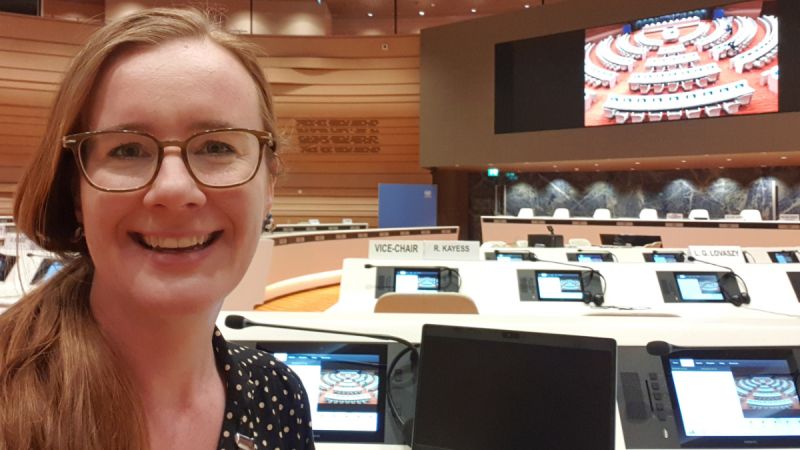
While working in the not-for-profit sector, she had done plenty of research identifying gaps in health, disability and refugee services systems to inform reform campaigns. But those reports would often languish when campaigns came to an end.
“One of the frustrations I had was that our team would do really good work. We came up with really good reports that had the voices of our stakeholders and proposed well-considered recommendations. But after a few years, they would kind of disappear.”
A PhD, on the other hand, offered the chance to create research outcomes that become part of a broader evidence base that is revisited by researchers in an ongoing conversation.
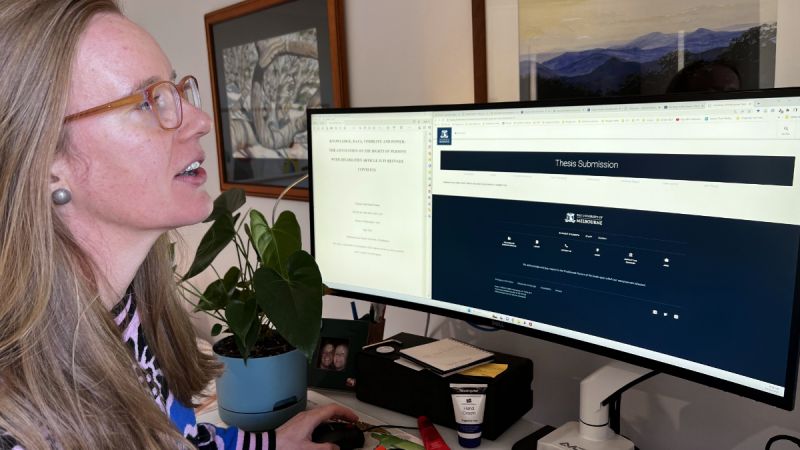
I thought, this research needs to be done. There’s no existing research, so who’s going to do it? Well, why not me? Dr Philippa Duell-Piening
After submitting her PhD, Dr Duell-Piening was approached by the Peter McMullin Centre on Statelessness to work on an Australia Research Council (ARC)-funded project Understanding Statelessness in Australia.
“I had the privilege of interviewing a whole lot of people who work with stateless people, and stateless people themselves, to try and understand how many people are stateless in Australia, and who they are.”
Dr Duell-Piening is also currently putting the final touches on the manuscript for a book based on her PhD. “It’s really exciting because I want this knowledge to be disseminated,” she says.
“Yes, the PhD process was about research training, but for me it was also largely about taking my analysis and the work I’ve drawn on, including my advisory group of people from refugee backgrounds with disability, and ensuring that work is shared, so that other people hear about it.”
She expects in response to her work there will be a range of views expressed on the issue of data production and processing, refugee displacement, disability and human rights.
“Of course, there will be other views, and I really welcome that. It’s about having the discussion, rather than saying ‘this is the answer’. While I do contribute some new ideas and provocations, I definitely don’t have ‘the answer’.”
Dr Duell-Piening’s book with her research findings will be released in early 2025.
First published on 4 December 2024.
Share this article
Keep reading
-
Why research with us
Explore the benefits of undertaking your graduate research at the University of Melbourne.
-
Your research options
Explore your options as a graduate researcher at the University of Melbourne.
-
Your study experience
Discover what it's like to be a graduate researcher. Find out about University life, support services, and opportunities for skills development.
-
How to apply
Find out how to apply for graduate research at the University of Melbourne.