4 Minute read
Future Generation Professor Jonathan Manton researches how things compute – whether the object doing the computing is a brain or a signal processing algorithm.
Professor Manton is an electrical engineer with broad research interests in mathematics, sustainable resources, neuroscience and systems biology. He completed his undergraduate studies and his PhD at the University of Melbourne. He now leads a program of smart mining and processing research.
You can research whatever you like, but the real question is: are you researching something that other people care about? By working with industry, you get a better feeling for what research is important. I do believe there's a role for fundamental research, but a balance is good. Fundamental research and applied research should inform each other.
We’re hoping to take our expertise in electrical engineering and apply that to a different set of problems. Anything to do with optimisation, decision-making or risk minimisation is something that we believe we have the skill set to do.
We need sustainable resources for the future of the planet. Anyone with children worries about the future. We're rapidly running out of precious resources.
The basic human desire to be more efficient and not to waste unnecessarily is a prime driver for this research. Professor Jonathan Manton
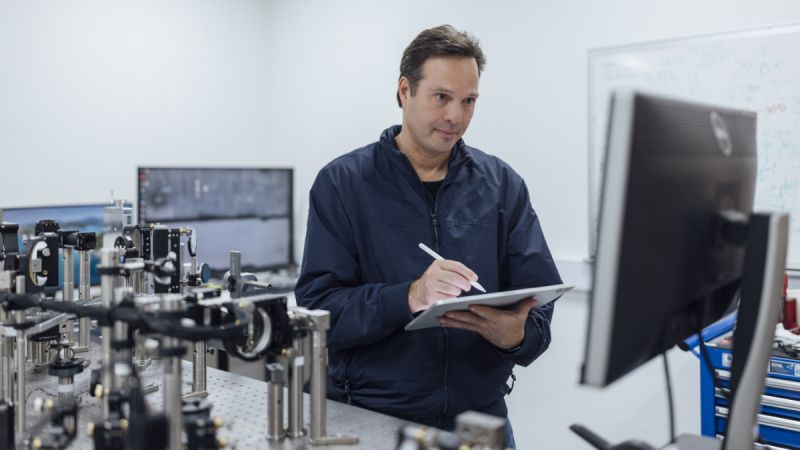
As an example, nuclear spectroscopy can be used to scan minerals in real time to monitor its quality and make faster decisions about where to dig. You hit your material with X-rays, and the energy of the light you receive back is representative of the molecules you’ve been hitting. When you want an answer quickly, you turn up the intensity of the X-rays and get pulses upon pulses upon pulses. Our task at the signal processing end is to identify each of these pulses in order to put up this spectrogram of what the energy levels are.
It's exciting to apply ideas in one discipline to another discipline. Mathematics gives you the language with which to rigorously represent something, and to reason about it. Engineering gives you your intuition about how systems work. And then you have your actual application area, like sustainable resources.
Of course having the generic skills doesn't mean you can immediately solve a problem. You do need domain expertise there. We like to work closely with our industry partners. We don't believe in just finding an industry problem to solve. Our partnerships are a close interaction where we benefit from their skills and they benefit from our skills.
Our research is about helping the resources industry make better decisions. You want better sensors to work out whether your mine is going to collapse, whether you’re drilling in the right place, or whatever you need to sense. You want better communication, because how do you get that information from a very large area back? You want better signal processing algorithms to extract as much information as possible – as every sensor you have is not going to be perfect. And you want control theory to close the loop and inform your decisions. You also want to have good models, because you want to know what will happen if you make a certain decision.
There are certain cases where machine learning works well, such as speech recognition. These are situations when you don't have to be perfect. You can tolerate a few mistakes here and there, and it's not really worth it to get hundreds of scientists to try to solve the problem.
I think people just need to be more selective about when to use artificial intelligence. Studies have shown that most of the time, neural networks do not do any better than other methods. In any area, including in smart mining, I think it's important to use the right tool for the right job. Sometimes that might be machine learning. But it's not a panacea.
We're looking at how you can bridge the gap between the task and artificial intelligence. The ideal vision is that you design a new network to do a task, rather than train it. A network we've designed and that we understand well is going to do that task well.
First published on 13 August 2024.
Share this article
Keep reading
-
Explore more Sustainable Resources research
Our research develops new mining and mineral processing technologies to reduce environmental impacts and increase the efficiency of resources extraction.
-
Partnerships
Find out how we can help to grow your organisation - from talent, to projects and partnerships.
-
Materials to feed the green energy revolution
Dr Kathryn Mumford leads research which supports the transition to green energy, reduces environmental impact and develops smart mining and processing.
-
Battery recycling makes economic and environmental sense
As demand for lithium batteries skyrockets, our engineers are seeking to close the loop between battery manufacturers and recyclers.