3 Minute read
Why is commercialisation important? What are the three most important factors in translating MedTech research? When should you spin out a company? A panel of experts with MedTech commercialisation experience discussed these questions and more at a recent University of Melbourne webinar.
Taking a medical device from a research idea to a manufactured product is complex. How can researchers and product developers ensure that their product meets real-world needs, satisfies regulatory requirements and can be successfully manufactured?
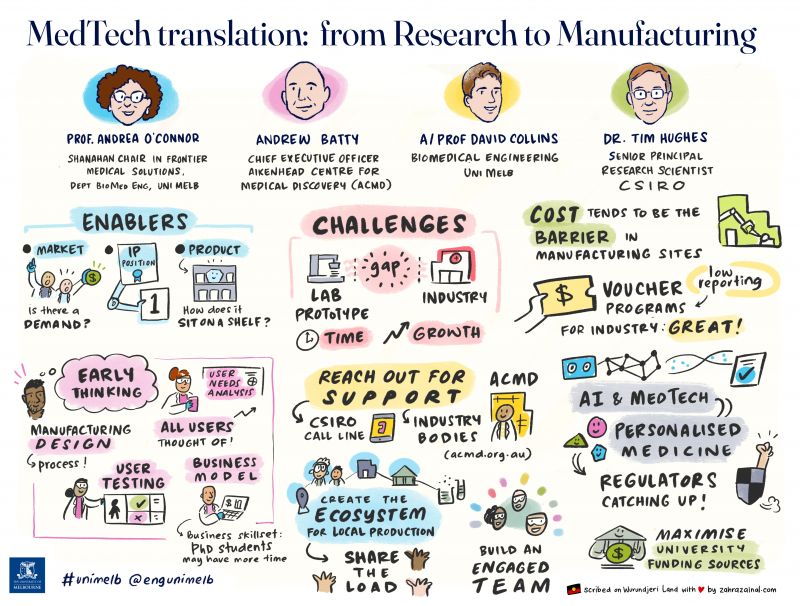
The University of Melbourne convened a panel of experts with experience of the MedTech commercialisation process to discuss. The panel discussion was chaired by University of Melbourne Shanahan Chair in Frontier Medical Solutions, Professor Andrea O’Connor.
We must design MedTech devices to user needs
Medical technologies can create solutions to many unmet clinical needs. And commercialisation is an important part of those solutions.
“A publication in Science is not going to save anyone’s life. Research needs to be adopted by a medical device company to be commercialised and sold to reach the patient,” said Andrew Batty.
Batty is a MedTech entrepreneur and the interim CEO of the Aikenhead Centre for Medical Discovery. He considers the three most important factors in translating a MedTech idea into a commercial product, in order of importance:
- What is the market for the device like?
- What is the device’s intellectual property position?
- What are the device’s features? How does it perform? Who is on the team?
Even a brilliant idea can fail if the market is too small, manufacturing the device isn’t cost-effective, or the regulatory hurdles are too high.
Ask yourself: why hasn’t someone done it before? Andrew Batty, interim CEO, Aikenhead Centre for Medical Discovery
To discover these problems, user testing can start at the ideation stage, the University of Melbourne’s Associate Professor David Collins said.
“You don’t need to have a prototype ready. You can user test the idea: ‘what if we did this? What if we built on or modified your process this way?’,” he said.
“Getting that feedback really early on in the process – before you do anything else – is going to be really instructive for guiding what direction your product or innovation is going to take.”
Successful innovations are designed for manufacture.
“A lot of what we do in a research environment is not necessarily amenable to large-scale production in an industrial setting,” said Dr Tim Hughes. Dr Hughes is the Research Team Leader at CSIRO Manufacturing Flagship, Australia.
When we fail to consider user requirements – from patients to hospital purchasing pathways to manufacturers – our innovations fail. But diverse teams can help.
Collaborations improve commercial chances
“Any people with skillsets or backgrounds that are going to be critical to your innovation need to be a part of the team,” said Associate Professor Collins.
Sharing ideas with larger groups of people is a risk, he admits. But it’s a risk worth taking, as “ideas on their own don’t go anywhere.”
Collaborations can power ideas along the commercialisation pathway, agreed Batty.
Once completed in March 2025, the Aikenhead Centre for Medical Discovery (ACMD) will host state-of-the-art biomedical engineering equipment and laboratories. With seven partners, including leading universities, research institutes, industry partners and a tertiary hospital, the ACMD can connect people with ideas to appropriate research teams.
Yet when starting collaborations, it’s important to be clear about who owns current intellectual property – and who will own any improvements and new intellectual property.
“Get it in writing and avoid the fighting,” Batty laughed.
When to spin out a company for MedTech innovations
Once you’re developing a product, when is the right time to spin out a company?
As late as possible in the product development process, Associate Professor Collins recommended.
This allows researchers to continue to access academic funding sources and discounts for facilities – while also being more attractive to investors.
“It’s very hard to sell an idea or even a prototype to an investor,” Associate Professor Collins said.
“But if you have essentially what is a finished product with a business model in mind – and you have a very convincing business case for that product – then that’s a much easier sell to a venture capital firm. And you’re going to get a higher valuation as well.”
First published on 11 September 2024.
Share this article
Keep reading
-
Explore more MedTech research
Creating transformative solutions for patient treatment and recovery. We bring together expertise from engineering, technology, medicine and science to develop tools to improve community health and individual patient outcomes.
-
Partnerships
Find out how we can help to grow your organisation - from talent, to projects and partnerships.
-
Made in Australia: How we’ll grow the local MedTech sector
The MedTech sector needs technical, regulatory and business skills. Our expert panel discussed what Australia’s skill gaps are and how to fill them.
-
New hope for patients who couldn’t get dental implants
One in ten patients with missing teeth can’t get a dental implant. In an Australian first, our researchers have designed an implant to help them.