Depending on whether it’s solo or in a pair, Heterochromatin protein 1 (HP1) is able to both silence and activate genes, highlighting a potential new approach for gene therapy.
In every human cell, approximately two metres of DNA is stored inside the nucleus, which is around 5 to 20 micrometres wide or one-quarter of the width of a human hair.
To fit into this tiny space, the DNA helix is wrapped tightly around proteins in a structure called chromatin. This essentially archives the DNA until it’s unravelled and used as a blueprint to make new proteins.
Earlier research found that Heterochromatin protein 1 (HP1) was involved in keeping DNA tightly bound, which represses or ‘silences’ the expression of genes.
But HP1 is also associated with opening the chromatin structure, enabling the genes to be ‘switched on’ or expressed.
For years, it was unclear how one protein could perform these seemingly opposite functions in different situations.
Now, a research team led by Associate Professor Elizabeth Hinde and Dr Jieqiong Lou, along with scientists from the University of Melbourne, Peter MacCallum Cancer Centre, WEHI, CSIRO, and Monash University, may have found the answer.
It isn't possible to visualise whether a DNA fragment is accessible to a protein using regular microscopy. To overcome this, the team employed advanced light microscopy to study how our genetic code is organised at the molecular level.
By tagging the molecules of interest with glowing fluorescent proteins (FPs), and using a photophysical phenomenon known as Förster resonance energy transfer (FRET) the researchers were able to measure nanometer-scale distance changes between molecules within the living nucleus.
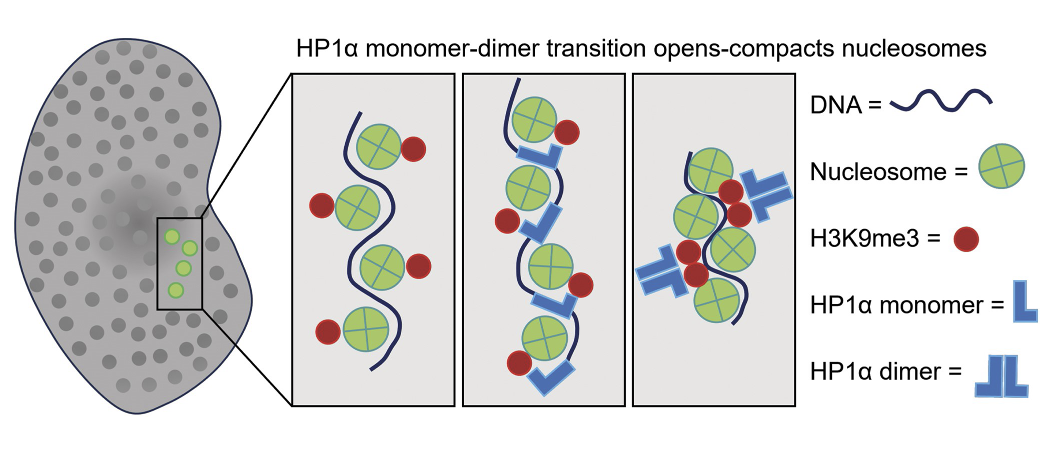
Based on FRET measurements, they found that HP1 can carry out both roles by switching between its monomeric (solo HP1) and dimeric (HP1 pairs) forms.
This finding is significant because it not only gives us a peek into the dynamic three-dimensional physical environment that stores our genetic material, but also suggests the possibility of manually activating or deactivating specific genes by controlling HP1 structural states.
Controlling HP1 states has potential applications in developing new therapies, such as gene therapy, by opening previously inaccessible DNA regions to facilitate gene editing.
This approach holds promise for treating conditions like cystic fibrosis, Duchenne muscular dystrophy, and sickle cell anaemia.
Additionally, HP1 could be utilised as an epigenetic gene therapy to alter gene accessibility and regulate gene expression without modifying the DNA sequence. Currently, epigenetic gene therapies show promising results in treating cancer, neurodegenerative diseases and cardiovascular disorders.
Next steps
The next step will be to determine when and how HP1 monomer and dimer are used. The team's new results suggest that switching HP1 from its dimeric to monomeric form can open up chromatin and help copy DNA when cells need to divide.
This is a fascinating example of how intelligent nature can be when managing our complex genetic blueprint.
Publication
Jieqiong Lou, Qiji Deng, Xiaomeng Zhang, Charles C Bell, Andrew B Das, Naiara G Bediaga, Courtney O Zlatic, Timothy M Johanson, Rhys S Allan, Michael D W Griffin, PrasadN Paradkar, Kieran F Harvey, Mark A Dawson, Elizabeth Hinde, Heterochromatin protein 1 alpha (HP1α) undergoes a monomer to dimer transition that opens and compacts live cell genome architecture, Nucleic Acids Research, Volume 52, Issue 18, 14 October 2024, Pages 10918–10933, https://doi.org/10.1093/nar/gkae720
Funding
Dr Jieqiong Lou is supported by the Excellence in Diversity Fellowship, the Faculty of Science, and the Kaye Merlin Brutton Bequest. My supervisor, A/Prof Elizabeth Hinde, is supported by an ARC Future Fellowship [FT200100401], ARC Discovery Projects [DP180101387 and DP21010298], and the Jacob Haimson Beverly Mecklenburg Lectureship.
Banner image: Getty Images
First published on 31 October 2024.
Share this article