The Priestley Scholars is a research partnership between the Universities of Birmingham and the University of Melbourne. Named after Sir Raymond Priestley, who was Vice-Chancellor of both universities, the program aims to foster research collaboration and nurture the next generation of talent in engineering and the natural sciences.
The program’s joint PhD candidates, the Priestley Scholars, work together with renowned academics across shared areas of priority research like energy storage, biomechanics, artificial intelligence and robotics. Together, researchers and candidates deliver innovative research.
Call for joint PhD projects 2025 – Melbourne Birmingham Priestley Scholars
In 2025, UoB and Melbourne are calling for project proposals from the Faculty of Engineering and Information Technology (FEIT) and the Schools of Computer Science, Chemical Engineering, and Metallurgy and Materials, and the Departments of Electronic, Electrical and Systems Engineering and Mechanical Engineering, to establish up to four (4) pairs of supervisors (PIs), with each supervisory team supporting one (1) joint PhD candidate.


Our partner: the University of Birmingham
The University of Birmingham boasts a rich heritage as England’s first civic university, a place where students of all backgrounds were accepted on an equal basis. Today, the university continues to embody this spirit with its mission of encouraging and empowering people of all backgrounds to turn ingenuity into reality. The 10 Nobel Laureates counted among Birmingham’s staff and alumni have contributed to some of science’s greatest discoveries, including in recent times the Higgs Boson and Gravitational Waves.
Project spotlight
Investigating delusions in early psychosis
To date, delusions have been predominantly studied from the perspective of cognitive psychology, which defines the condition in a rigid and negative manner. Delusions are portrayed as universally negative and inherently dysfunctional experiences. While delusions might contain errors of fact and are often distressing, recent philosophical and psychological literature has suggested that certain delusions can be experienced as enhancing one’s sense of meaning in life. This project aims to advance the research in this area by conducting an unprejudiced investigation into the experience and meaning of delusions in early psychosis.

Priestley Scholar news
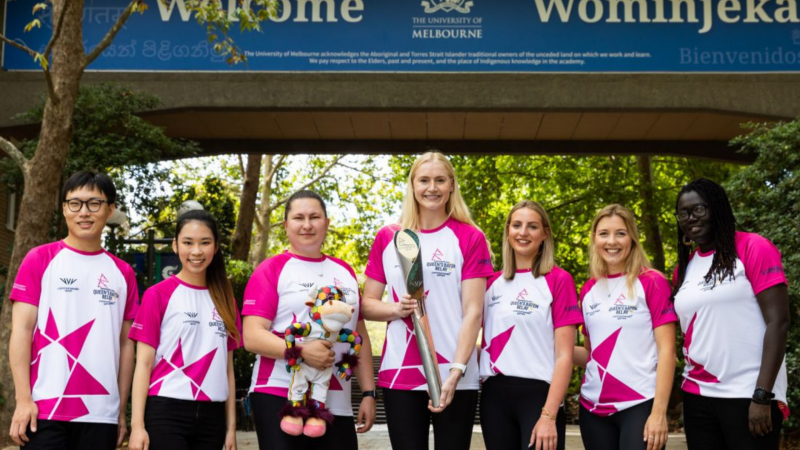
Mo Zhang takes part in Queen's Baton Relay
Seven Batonbearers – athletes and students from the University of Melbourne and University of Birmingham - marked the Queen’s Baton Relay arrival in Australia, running with the Baton across the Parkville campus in Melbourne. Part of the contingent is Mo Zhang, a Priestley Scholar who is currently undertaking his joint PhD with the universities of Birmingham and Melbourne. The event, hosted by the two universities, celebrated the arrival in Australia of the Birmingham 2022 Commonwealth Games Queen’s Baton Relay, of which the University of Birmingham is an official partner.
It will always be an honour to be a joint PhD candidate at these two great universities. Special thanks for the support through the COVID-19 pandemic. Mo Zhang Priestley Scholar
Meet our academic leads
A/Prof Vijay Rajagopal is an expert in computational physiology, he creates anatomically and physiologically realistic computational models of biological systems (sometimes called digital twins). He uses these models to test scientific hypotheses about how biological systems work and applies them in clinical and pharmaceutical applications for translational impact. A fundamental focus of A/Prof. Rajagopal's group is about developing models to uncover how living cells work.


Pola Goldberg Oppenheimer is a Professor in Micro-Engineering and Bio-Nanotechnology at the School of Chemical Engineering and the Healthcare Technologies Institute (HTI). Prof. Oppenheimer leads an interdisciplinary research group at the University of Birmingham, closely working with the clinical teams at the Queen Elizabeth Hospital and Birmingham Enterprise (UoBE), the University’s technology transfer specialists. Professor Oppenheimer is developing cutting-edge Engineering solutions to tackle major medical problems.
-
Search current opportunities
Search for any current International Research Training Group joint PhD opportunities.
-
How to apply
Apply for a joint PhD with the Priestley Scholars.
-
Contact us
Contact The Priestly Scholars.
Keep reading
-
International PhD opportunities
Discover the fully funded joint PhD opportunities that are currently available with universities and research institutions around the world.
-
Your research options
Explore your options as a graduate researcher at the University of Melbourne.
-
Your study experience
Discover what it's like to be a graduate researcher. Find out about University life, support services, and opportunities for skills development.
-
Find a supervisor or research project
Discover how to find a supervisor and learn how they can support your graduate research, or search available research projects.