Reflections from Space Curation Camp
Five University of Melbourne PhD candidates recently experienced a first-of-its-kind Space Curation Camp at the Institute of Space and Astronautical Science (ISAS) in Japan.
ISAS, which is part of the Japan Aerospace Exploration Agency (JAXA), is one of the world’s leading institutes for space science. It led Hayabusa, the first mission to successfully collect and return rock samples from an asteroid, and Hayabusa 2, its sequel asteroid mission. It will soon launch the Martian Moons eXploration (MMX) project, which aims to be the first mission to collect and return samples from one of the Martian moons.
The intensive three-week Space Curation Camp is offered through the Melbourne-UTokyo-JAXA Collaborative PhD program – part of a larger international research partnership between the University of Melbourne, the University of Tokyo and JAXA, in the broader context of Australia-Japan cooperation.
Alongside high-priority research questions, the Collaborative PhD Program also serves to co-develop future generations of space researchers at the intersection of academia, industry and Government.
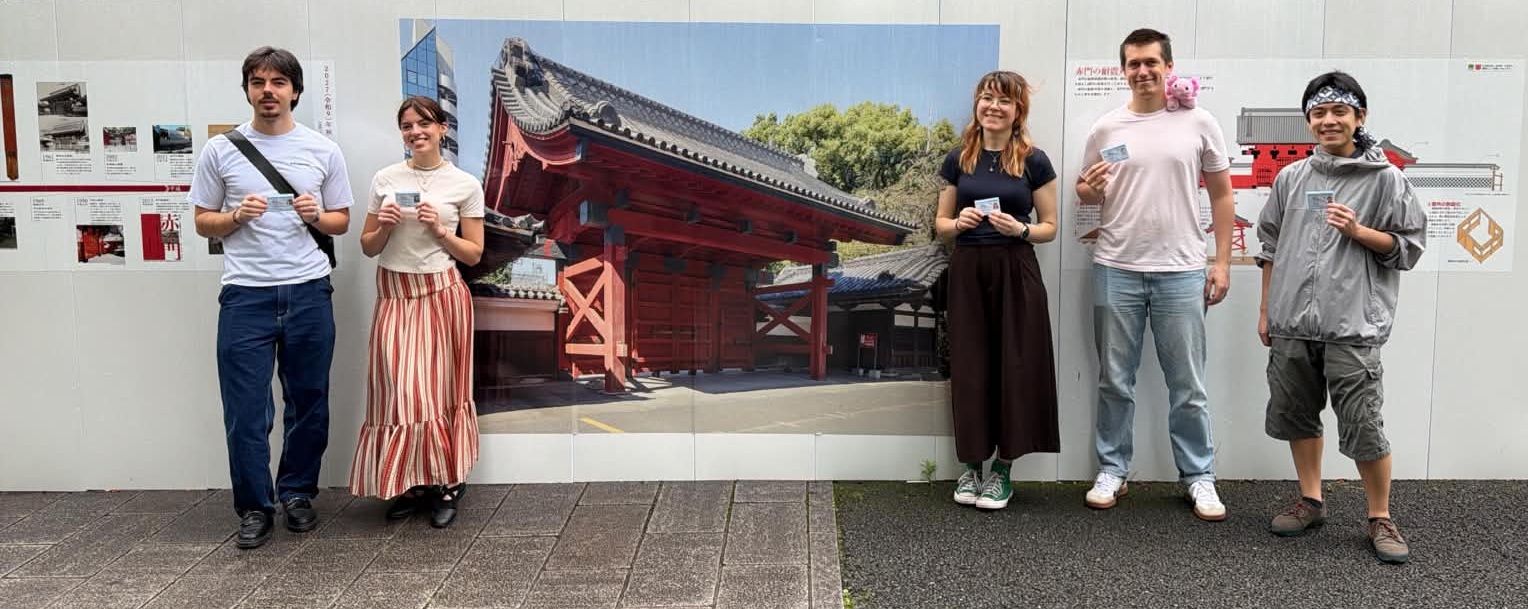
(L-R): Lucas Pellequer, Maisie Haddock, Kasper Tomaš, Hugo Gouilloux and Kensaku Moriya holding their University of Tokyo student ID cards at UTokyo's Hongo campus after being enrolled as Special Research Students for space camp.
Partnership Academic Lead, Dr Brandon Mahan, said the camp offered candidates at the beginning of their PhD journeys a unique research opportunity to acquire new skills and experiences within some of the world’s best space laboratories and teaching facilities.
“The immersive experience purposefully builds community and connection between the researchers and their supervisors from the University of Melbourne, as well as mentors and collaborators from UTokyo and JAXA,” Dr Mahan said.
“Learning from global leaders in space science and establishing career-long professional relationships is a really exciting part of the program.
“The new knowledge and techniques gained by the graduate researchers around processing and analysing samples provide novel research outcomes in themselves, and directly apply to their research projects at the University of Melbourne – which focus on safely transporting and analysing planetary samples from existing and future sample-return space missions.”
The PhD researchers reflected on their highlights from the camp.

Hugo Gouilloux
“Visiting the Extraterrestrial Sample Curation Center (ESCuC) at JAXA was incredible. We saw samples of the Ryugu asteroid, the target of a previous return sample mission Hayabusa2 led by JAXA. I learnt about how to sample contamination in clean environments, processing samples and results, and other ways to represent collected data for presentations and reports.”

Maisie Haddock
“When I tell people I’ve been to space camp, the first thing they say is how unbelievably cool it sounds – and it really is. As a first‑generation student, those reactions mean a lot to me. Opportunities like this aren’t something I grew up expecting or even knew were possible. Being able to say I participated in this dedicated research visit and handled rare meteorite samples is nothing short of exhilarating.”
Kensaku Moriya
“A new skill I gained from the camp is a non-destructive 3D analysis to explore the internal texture of a sample, which is crucial for meteorites or returned space mission samples that are difficult or almost impossible to reproduce. I also had the privilege of gaining hands-on experience with a recently developed technique that analyses the thermophysical property of a sample, working with the person who developed the method.”
Lucas Pellequer
“The biggest surprises were the labs at the University of Tokyo and the clean room at JAXA, which looked like something out of a sci-fi film. My background is purely engineering, so being able to learn about instruments and measurements from chemistry and geoscience perspectives I had never considered felt genuinely unreal. Seeing the wind tunnel facility also brought to life the data I use to validate my simulations.”

Kasper Tomaš
“Meeting some of the top space researchers was mind-blowing. I learnt tools to understand the size and morphology of particles, new computer vision techniques, and how to actually apply skills I’d only learnt in theory. I plan to continue an environment that I saw of open science and collaboration in my own research. It was one of the most rewarding professional experiences I’ve had.”
The University of Melbourne is a member of an International Partnership for research with JAXA, the University of Bern, the Australian Space Agency (ASA), UK Science Museum, National Astronomical Research Institute of Thailand (NARIT) and the International Astronomical Union (IAU).
First published on 8 October 2026.
Share this article